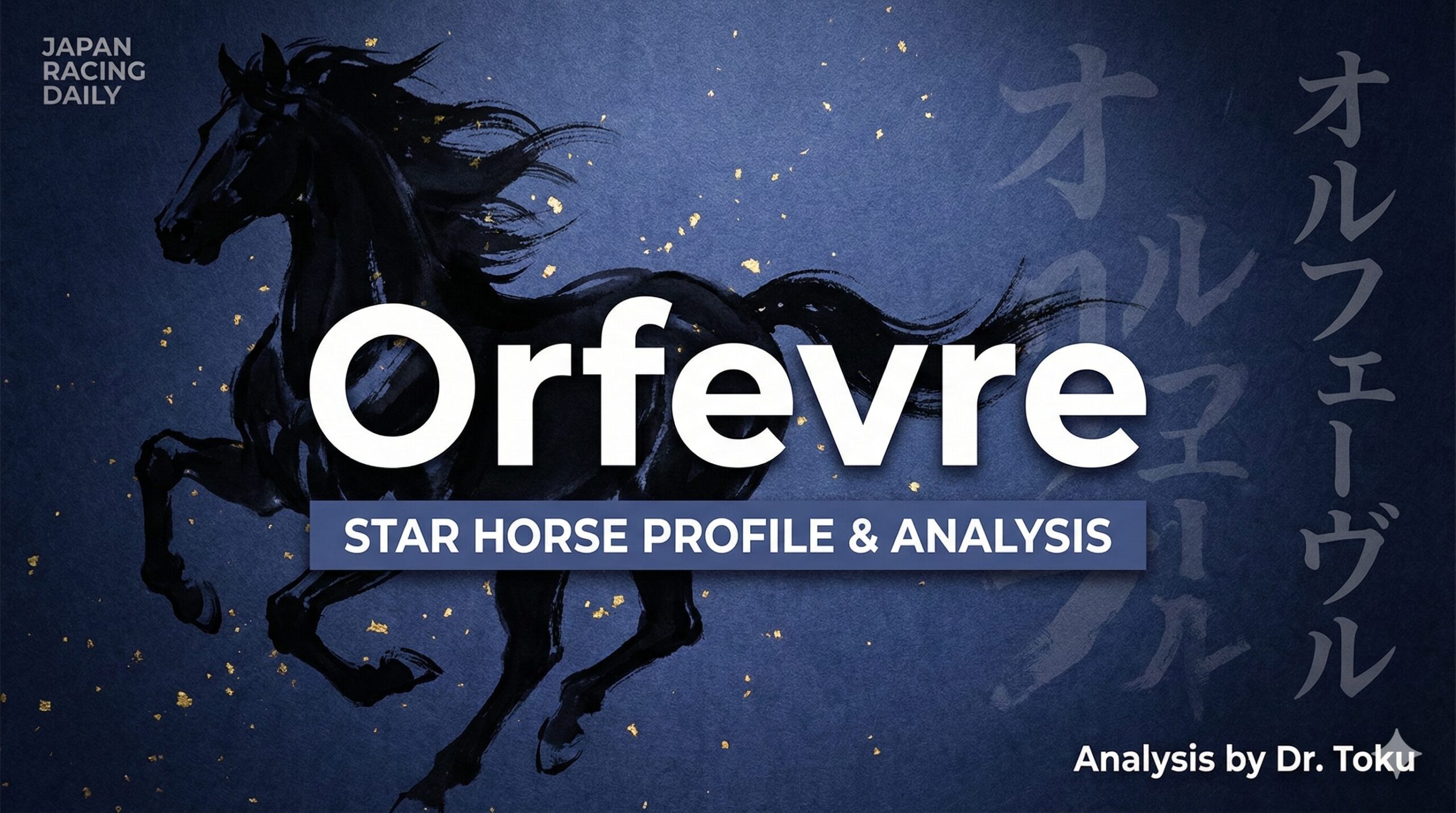
Hello, racing fans and trainers from around the world! I am Dr. Toku, a veterinarian here to guide you through the anatomy and psychology of Japan’s most legendary thoroughbreds.
Today, we are dissecting the “Golden Tyrant.” If you know Orfevre from Umamusume, you know her as the arrogant, mask-wearing Queen who claims the turf as her territory, declaring “I am the King.” But let me tell you: the real horse was even more dramatic, more volatile, and perhaps the most talented horse in Japanese history.
Here is the medical and historical breakdown of the 7th Triple Crown winner, the Golden Beast, Orfevre.
The Hook: The King Who Wore a Mask
In Umamusume, Orfevre is depicted as “The Tyrant” (Bōkun)—a character of immense charisma and overwhelming pride. This isn’t just anime exaggeration. The real Orfevre was a chestnut stallion with a golden mane who frequently threw his jockey, ran off course, and terrified his handlers. He didn’t just win; he humiliated his opponents. He was a genius and a madman wrapped in a golden coat.
His debut set the tone for his entire career: he won the race, but immediately after crossing the finish line, he bucked off his jockey, Kenichi Ikezoe, and ran loose. From day one, he told us, “I run because I want to, not because you tell me to.”
The Career: A Golden Storm
Orfevre’s career was a rollercoaster of extreme highs and heart-stopping lows. He was the hero of the recovery generation, rising to power in 2011, the year of the Great East Japan Earthquake.
- The Triple Crown (2011): He dominated the Satsuki Sho, Tokyo Yushun (Japanese Derby), and Kikuka Sho to become only the 7th Triple Crown winner in history. His Derby win in the mud was particularly ferocious.
- The Arima Kinen (2011 & 2013): He won the year-end “Grand Prix” twice. His retirement race in 2013 was a massacre where he won by 8 lengths—one of the most decisive victories in G1 history.
- The Heartbreak in France (2012 & 2013): He finished 2nd in the Prix de l’Arc de Triomphe twice. In 2012, he looked like the winner, accelerating past the field, until he suddenly swerved into the rail in the final meters, snatching defeat from the jaws of victory.
- Key Rivals:
- Gentildonna: The Triple Crown Filly who famously shoved Orfevre aside to win the 2012 Japan Cup in a physical duel.
- Gold Ship: His younger half-brother (same father, Stay Gold) and fellow “problem child” of Japanese racing.
Dr. Toku’s Vet Analysis: The Anatomy of a Tyrant
As a veterinarian, Orfevre is a fascinating case study. He wasn’t built like a tank, but he moved like a finely tuned sports car.
- Physique – The “Average” Miracle: Unlike giants like Kitasan Black (540kg), Orfevre was relatively small to average, racing around 440kg to 460kg. When he was born at Shiraoi Farm, staff noted he looked “average” and like his mother. He wasn’t muscularly imposing at first glance, but his muscle density was extraordinary.
- The “Stay Gold” Temperament: Biologically, he inherited the extreme volatility of his father, Stay Gold. In veterinary terms, we often see that high-strung horses have higher adrenaline responses. Orfevre had a “soft mouth” (sensitive to the bit) but a stubborn mind. This combination meant that if he decided he didn’t want to run, he wouldn’t. But if he did decide to run, his explosive energy was unmatched.
- Super-Compensation Recovery: After his hard-fought victory in the Satsuki Sho, he was exhausted. However, trainer Yasutoshi Ikee noted that within a week, his body had not only recovered but improved. His cardiopulmonary function was elite, allowing him to bounce back from fatigue faster than any normal horse.
- Motor Control: His stride wasn’t just long; it was incredibly flexible. He could corner at high speeds (when he wasn’t running off course). His ability to accelerate instantly (his “turn of foot”) suggests a high composition of Type IIb fast-twitch muscle fibers, characteristic of the “Stay Gold x Mejiro McQueen” genetic nick.
Legendary Episode: The “Hanshin Escapade”
If you want to understand why we call him the “Tyrant,” you must look at the 2012 Hanshin Daishoten.
It was a 3000m race. Orfevre was the overwhelming favorite (1.1 odds).
- The Incident: Around the 2nd corner, he seemingly got bored or frustrated. He stopped racing and ran wide, almost hitting the outside fence.
- The Drop: He decelerated so much he looked like he was pulling up from an injury. The pack passed him. He was effectively last.
- The Return: Suddenly, seeing the other horses leave him triggered his competitive instinct. He re-accelerated.
- The Finish: He made up an impossible amount of ground, ran the fastest final 3 furlongs, and finished 2nd, missing the win by only half a length.
It was a loss, but it was more impressive than most wins. It proved that physically, he was leagues above everyone else; he was only limited by his own mood.
Witness the Legend
To truly understand his power, you must watch these two moments.
The Triple Crown Moment (2011 Kikuka Sho): Watch how he dominates the field to become the 7th Triple Crown winner.
The Final Performance (2013 Arima Kinen): His retirement race. Watch the 8-length lead at the end. He didn’t just win; he destroyed the competition to say goodbye.
Connection to Modern Horses
Orfevre retired to Shadai Stallion Station and has proven that his “mad genius” bloodline is potent. He is surprisingly versatile, producing champions on both Turf and Dirt.
- Ushba Tesoro: A current superstar who won the Dubai World Cup. He inherited Orfevre’s stamina and closing speed, dominating on dirt.
- Marche Lorraine: Shocked the world by winning the Breeders’ Cup Distaff in the USA (the first Japanese horse to win a dirt G1 in the US).
- Lucky Lilac: A slightly more well-behaved daughter who won multiple G1s including the Osaka Hai.
Orfevre’s legacy is that of a “home run hitter.” His children can be difficult to train, but when they click, they conquer the world—just like their father.
Dr. Toku’s Prescription: Orfevre is a reminder that perfection isn’t about being well-behaved. It’s about raw, uncontrollable talent. If you love the “Tyrant” in Umamusume, you now know that the real horse was a creature of beautiful chaos.


Comments