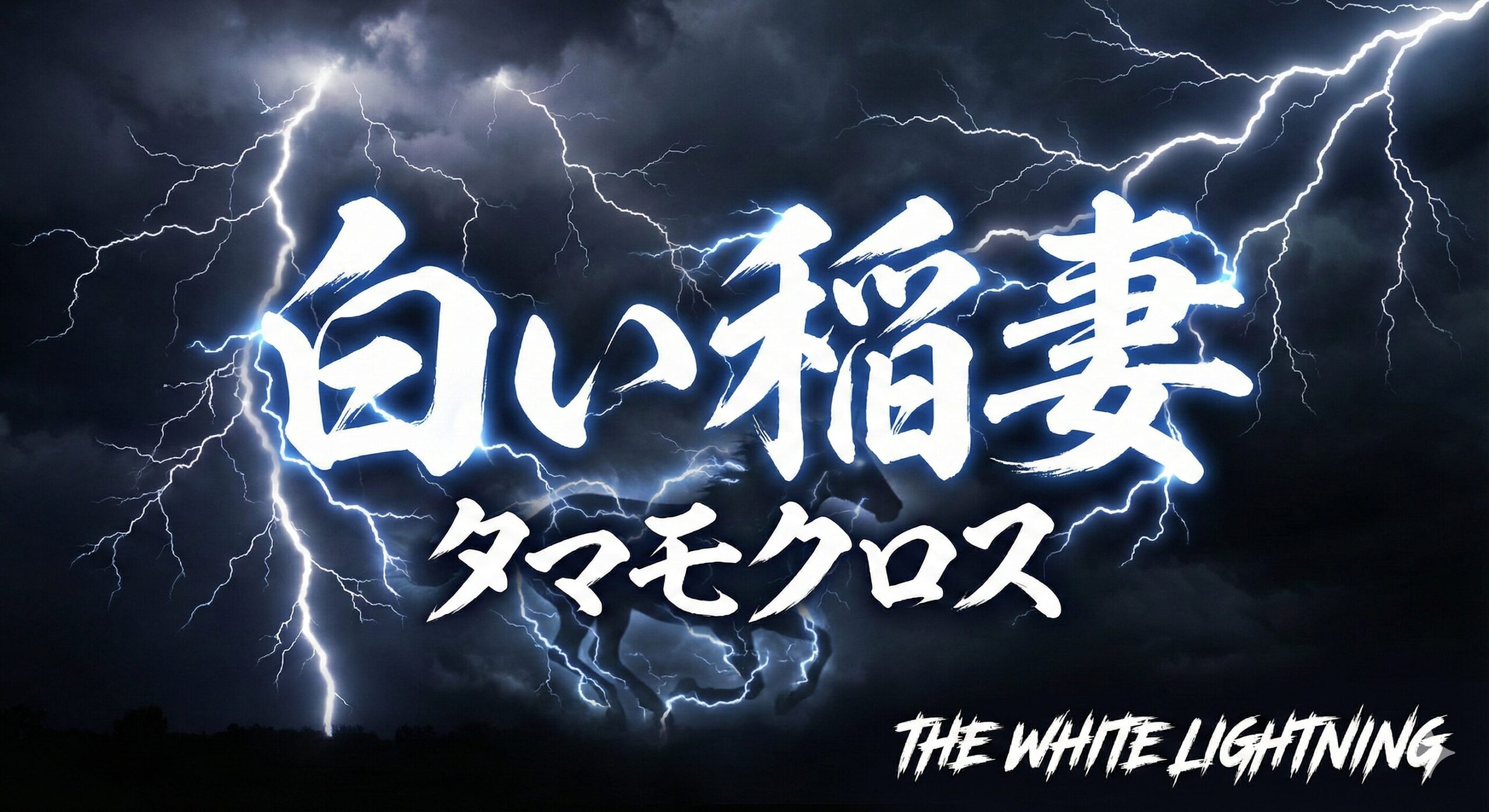
In the pantheon of Japanese horse racing, few stories are as dramatic or heart-wrenching as that of Tamamo Cross. Before he was the feisty, Kansai-dialect speaking girl in Umamusume: Pretty Derby, he was a racehorse who carried the weight of a bankrupt farm on his small shoulders.
Known as the “White Lightning” (Shiroi Inazuma), Tamamo Cross emerged during Japan’s “Golden Era” of racing in the late 1980s. He wasn’t just a fast horse; he was a symbol of resilience. He rose from obscurity to challenge the world, culminating in a rivalry that would define a generation of fans.
For fans of the anime, understanding the real Tamamo Cross horse adds a profound layer of depth to the character you know and love. Let’s dive into the history of the grey legend who struck the turf like lightning.
Above: The anime adaptation of Tamamo Cross captures his small stature and fierce “hungry spirit.”
The “Rags to Riches” Origin: Born from Tragedy
To understand the spirit of Tamamo Cross, you must first understand where he came from. Unlike the elite horses born into the luxury of Shadai Farm or Mejiro Bokujo, Tamamo Cross was born at Nishiki no Bokujo, a small farm facing financial ruin.
The story is famously tragic. By the time Tamamo Cross was a foal, the farm was on the brink of bankruptcy. To pay off mounting debts, the farm was forced to sell their beloved broodmare, Green Chateau (Tamamo Cross’s mother). The separation was devastating for the farm owners, who pinned their last hopes on the small, grey colt she left behind.
Sadly, the farm could not be saved. Nishiki no Bokujo went bankrupt, and the “Tamamo” owner stepped in to buy the colt, effectively saving him from an uncertain fate. This backstory is the direct inspiration for the Tamamo Cross Umamusume character’s obsession with money, sales, and her desperate desire to support her family. The “Hungry Spirit” she speaks of in the anime is not a gag—it is a historical reference to a horse fighting for the legacy of a lost home.
Profile Summary: Tamamo Cross
| Feature | Details |
| Birth Date | May 23, 1984 |
| Sire | C.B. Cross (Grey Sovereign Line) |
| Dam | Green Chateau |
| Coat Color | Grey (Ashige) |
| Career Record | 18 Starts: 9 Wins, 3 Seconds |
| Principal Wins | Tenno Sho (Spring), Tenno Sho (Autumn), Takarazuka Kinen |
| Nickname | The White Lightning |
While his pedigree (the Grey Sovereign line) was respected, it wasn’t considered “top tier” like the Northern Dancer lines becoming popular at the time. Yet, his father, C.B. Cross, was known for a devastating chase style, a trait his son would inherit and perfect.
The Awakening of the White Lightning
Tamamo Cross did not start as a superstar. In fact, his early career was plagued by health issues and a fragile constitution. He was a picky eater and often thin, which worried his trainers. Throughout 1987, he struggled in lower-class races, often losing on dirt tracks or failing to find his rhythm.
However, in the autumn of 1987, something changed. The horse began to fill out. His temperament settled. When he returned to the turf, the “White Lightning” finally struck.
Beginning in October 1987, Tamamo Cross began an incredible winning streak. He didn’t just win; he dominated. His racing style became his trademark: he would lurk in the back of the pack, conserving energy, and then unleash an explosive burst of speed in the final 200 meters.
Watch the final straight: Tamamo Cross (Grey) unleashes his signature acceleration to capture his first graded title.
By the start of 1988, the racing world had taken notice. The skinny horse from the bankrupt farm was now a force of nature. His victory at the Sports Nippon Sho Kimpai proved that his previous wins were no fluke.
The Awakening continues: Tamamo Cross dominates the field, setting the stage for his G1 campaign.
The G1 Era: Conquering the Spring Shields (1988)
1988 is often cited by historians as one of the greatest years in JRA history. For Tamamo Cross, it was the year he became a legend.
His first major test was the Tenno Sho (Spring), the most prestigious long-distance race in Japan (3,200 meters). Critics doubted whether a horse with such an explosive “sprint-like” kick could handle the grueling stamina test. Tamamo Cross silenced them all. He settled beautifully and drained the endurance of his rivals before striking.
The moment of glory: Tamamo Cross captures the Emperor’s Shield, proving his stamina matches his speed.
He didn’t rest there. He proceeded to the Takarazuka Kinen, the “Grand Prix” of the spring season where fans vote for the entries. Facing the best middle-distance horses in the country, the white lightning horse struck again, proving he was the undisputed King of the Spring.
Versatility on display: Winning at 2,200m against a top-class field to cement his status as the best older horse in Japan.
The “Grey Showdown”: Tamamo Cross vs. Oguri Cap
While Tamamo Cross was ruling the older division, a monster had arrived from the local leagues. A younger grey horse named Oguri Cap had transferred to the JRA and was on a terrifying winning streak of his own.
The media dubbed it the “Grey Showdown” (Ashige Taiketsu).
- Tamamo Cross: The reigning Emperor. The small, sharp technician.
- Oguri Cap: The challenger. The muscular, power-running idol.
This rivalry is the central plot point of the manga and anime Umamusume Cinderella Grey. But the reality was just as dramatic as the fiction.
The 1988 Tenno Sho (Autumn)
The two greys finally met at the Tenno Sho (Autumn). The atmosphere was electric. Oguri Cap was the favorite, riding a wave of populist support. But Tamamo Cross was not ready to hand over his crown.
In a race that is still analyzed today, Tamamo Cross stayed ahead of Oguri Cap. When Oguri tried to pass, Tamamo Cross dug deep, unleashing a second wind that held the younger horse at bay.
With this victory, Tamamo Cross became the first horse in history to win both the Spring and Autumn Tenno Sho in the same year—a monumental feat.
History in the making: Tamamo Cross holds off the charging Oguri Cap to complete the “Spring-Autumn Double.”
For fans of Cinderella Grey, this is the moment where Tamamo enters “The Zone.”
The intensity of the rivalry is perfectly captured in the recent anime adaptation.
The Final Battles: Japan Cup & Arima Kinen
Following his historic double, Tamamo Cross aimed for the world: The Japan Cup.
In 1988, the Japan Cup was truly international. He faced Pay the Butler, a fierce American horse, and Tony Bin (who would later become a legendary sire in Japan).
It was a muddy, grueling race. Tamamo Cross fought valiantly, weaving through traffic to challenge Pay the Butler, but fell just short, finishing 2nd. It was a loss, but it proved Japanese horses could stand toe-to-toe with the world’s best.
A gallant defeat: Tamamo Cross (2nd) battles the American horse Pay the Butler to the line.
The Passing of the Torch: Arima Kinen
His final race was the 1988 Arima Kinen. Once again, it was Tamamo Cross vs. Oguri Cap.
This time, the roles reversed. Tamamo Cross, perhaps tired from a long year, couldn’t hold off the younger beast. Oguri Cap took the win, and Tamamo Cross finished a strong 2nd.
It was the perfect end to a rivalry. The King had passed the torch to the Prince.
The Finale: Tamamo Cross runs his final race, finishing 2nd to his greatest rival, Oguri Cap.
Tamamo Cross in Umamusume: Fact vs. Fiction
If you entered this article searching for tamamo cross umamusume, you might be wondering how accurate the anime depiction is. The answer? Surprisingly accurate.
- Small Stature: In the anime, Tamamo is sensitive about being small. The real horse was indeed smaller than average (around 450kg), especially compared to the massive Oguri Cap.
- The “Discount” Obsession: Her gag about loving sales and cheap food is a direct nod to the poverty of Nishiki no Bokujo. The “Hungry Spirit” is not just an anime trope; it was the reality of his survival.
- The Lightning Effect: When Tamamo activates her skill, she is surrounded by blue/white lightning. This visualizes the “Shiroi Inazuma” nickname given to him by racing commentators for his flashy grey coat and electric acceleration.
- Relationship with Oguri: They are depicted as bickering roommates and rivals. In reality, they were the two pillars of the 1988 season. Their rivalry elevated horse racing in Japan to a social phenomenon.
Conclusion
Tamamo Cross retired with a record of 9 wins in 18 starts and over 490 million yen in earnings. But his legacy goes beyond the numbers. He was a horse that proved origin didn’t define destiny. He rose from a bankrupt farm to become the strongest horse in Japan, completing a Tenno Sho double that wouldn’t be touched for years.
For Umamusume fans, he is the feisty “White Lightning.” For racing historians, he is the bridge to the modern era, the rival who made Oguri Cap a legend.
If you ever watch the replays linked above, look for the grey horse with the white nose. Watch him wait, watch him endure, and wait for the lightning to strike.






Comments