
The unbelievable true story behind Umamusume’s most chaotic character.
If you have spent even five minutes diving into the vibrant, colorful world of Umamusume: Pretty Derby, you have undoubtedly encountered her. She is the one selling yakisoba in the background of a serious race scene. She is the one drop-kicking her trainer. She is the one walking around with a Rubik’s Cube, breaking the fourth wall, and defying every trope of the “serious athlete.”
She is Gold Ship.
For international fans of the franchise, Gold Ship often feels like a comic relief character created purely for laughs—a chaotic element designed to keep the game and anime from becoming too self-serious. Surely, no real animal could be that erratic, that stubborn, or that bizarrely intelligent. A horse that trolls the audience? It sounds like a writer’s invention.
But here is the truth that every Japanese racing fan knows: The Umamusume character is not an exaggeration. If anything, the developers had to tone him down.
The real Gold Ship was a superstar racehorse who captured the hearts of a nation not just because he was strong—though he was undeniably one of the strongest stayers in history—but because he was completely unpredictable. He was a horse who could pull off miraculous victories that defied the laws of physics, only to completely refuse to run in the next race because he simply didn’t feel like it.
In this article, we are going to strip away the anime aesthetic and look at the real animal. We will explore the gold ship umamusume connection, dive deep into the gold ship racehorse history, and explain exactly why this Ashige (grey) beast became a cultural icon in Japan. Whether you are a gamer trying to understand the lore or a racing fan looking for one of the sport’s greatest stories, this is the legend of the “Unsinkable Ship.”
Who Is Gold Ship? (For Readers New to Japanese Horse Racing)
Before we analyze his complex psyche, we need to establish his credentials. Gold Ship was not a novelty act or a circus pony; he was a legitimate champion who dominated the highest levels of the sport.
Born on March 6, 2009, Gold Ship was an Ashige—a grey horse whose coat whitened significantly as he aged. In his youth, he was a dark, steel grey, but by the time he retired, he was nearly pure white, giving him a ghostly, majestic appearance that contrasted sharply with his rugged, bullying racing style. He was a large horse, often weighing over 500kg (1,100 lbs), possessing a massive stride and incredible stamina.
In the structure of Japanese horse racing, the highest level of competition is the Grade 1 (G1) race. These are the equivalents of the Kentucky Derby, the Breeders’ Cup, or the Prix de l’Arc de Triomphe. Winning one G1 is the highlight of most thoroughbreds’ lives. Gold Ship won six.
His era, running from 2011 to 2015, was a golden age of Japanese racing. He competed against some of the greatest horses to ever set foot on turf. Yet, even among titans, Gold Ship stood out. He was known primarily as a “stayer”—a horse that excels at long distances (2,400 meters to 3,200 meters). Japanese racing places a high premium on stamina, and Gold Ship had an endless tank. He could sustain a long, grinding run that broke the spirits of lighter, faster opponents.
However, his reputation in Japan wasn’t built solely on his trophy case. It was built on the terrifying anxiety he induced in bettors. When you bet on Gold Ship, you weren’t betting on whether he was physically capable of winning; you were betting on his mood. If he decided to run, he was unbeatable. If he decided he was bored, he would sink your ticket without a second thought. This dichotomy made him the “Silver Screen Hero” with a villain’s temperament, a beloved rogue who kept the entire sport on its toes for half a decade.
A Champion With a Mind of His Own: Gold Ship’s Racing Career
To understand the gold ship real horse, you cannot just look at a spreadsheet of his results. You have to look at how he won, because his style was as unconventional as his personality.
Gold Ship’s career began in 2011, and he quickly established himself as a force to be reckoned with. But it was in 2012, during his three-year-old Classic season, that the legend was truly born. The defining moment—the race that is still discussed in hushed tones by handicappers—was the Satsuki Sho (Japanese 2000 Guineas).
The “Warp” of the Satsuki Sho
The Satsuki Sho is the first leg of the Japanese Triple Crown. On that day in April 2012, the Nakayama Racecourse was in a terrible state. The ground was officially listed as “soft,” but in reality, the inside of the track was a bog. It was churned-up, heavy mud that sucked the energy out of horses’ legs.
Conventional racing wisdom dictates that when the inside is muddy, you steer wide. You lose distance by going outside, but you gain better footing. As the field approached the final corner, almost every jockey pulled their horse to the outer lanes to avoid the quagmire.
Gold Ship was dead last. In a normal race, on a track like that, he had zero chance.
Then, his jockey, Hiroyuki Uchida, made a decision that seemed insane. Instead of following the herd to the outside, he steered Gold Ship to the absolute inside—directly into the worst of the mud. It looked like a suicide move. But Gold Ship didn’t care about the mud. He engaged what fans now call his “warp drive.”
You can see this unbelievable inside run for yourself in the race footage below.
While the other horses were struggling to corner wide, Gold Ship plowed through the inside mud as if it were paved concrete. In a matter of seconds, he teleported from the back of the field to the front. It wasn’t just a pass; it was a demolition. He took the lead and held it to the wire. The footage remains one of the most shocking displays of power in JRA history. It proved that Gold Ship wasn’t just fast; he was a tank.
The Rise of the People’s Horse
He followed this up with a victory in the Kikuka Sho (Japanese St. Leger), the third leg of the Triple Crown, proving his dominance over long distances. At the end of the year, he won the prestigious Arima Kinen.
The Arima Kinen is unique in Japan because the horses are chosen by fan vote.
It is the “All-Star Game” of racing. Gold Ship’s victory there cemented his status as the “People’s Horse.” He wasn’t a sleek, aristocratic runner; he was a rough-and-tumble brawler who won by grinding his opponents into the dirt.
However, alongside the brilliance came the chaos. For every miraculous “warp,” there was a race where he simply didn’t show up. In the 2013 Tenno Sho (Spring), he finished 5th despite being the heavy favorite. In the 2013 Japan Cup, he finished 15th—a dismal performance for a horse of his caliber.
Fans loved him despite this inconsistency. In fact, they loved him because of it. In a sport increasingly dominated by data, analytics, and precise breeding, Gold Ship was an agent of chaos. He was a reminder that horses are living, breathing creatures with their own agendas. He won the Takarazuka Kinen twice (2013, 2014), a historic feat, proving that when the stars aligned and his mood was right, he was the king of the turf. But as we will see, that “mood” was a fragile thing.
Why Was Gold Ship So Unpredictable?
This is the most important question for anyone trying to understand the gold ship personality. Why would a horse with enough talent to be the greatest of all time frequently sabotage himself?
The answer lies in his intelligence. Veterinarians, trainers, and jockeys who worked with Gold Ship all said the same thing: He was too smart for his own good. He wasn’t a “wild” horse in the sense that he was scared or feral; he was arrogant. He knew he was strong, he knew what the job was, and he often decided it wasn’t worth the effort.
His unpredictability manifested in several famous ways, most notably his relationship with the starting gate.
The Gate Troubles
In horse racing, the start is crucial. You need to break cleanly to get a good position. Gold Ship, however, often hated the starting gate. He viewed the narrow stall as an insult. He would sometimes rear up, roar, or thrash around before the doors opened.
This led to his infamous “slow starts.” He would often exit the gate seconds after the other horses, spotting the field a massive lead. The fact that he often won despite these terrible starts only added to his mystique. It was as if he was giving his opponents a head start to make it interesting. Bettors would watch the start with their hands over their eyes, praying he would just jump out normally.
The 120 Billion Yen Incident (2015 Takarazuka Kinen)
The most infamous incident—the moment that is forever burned into the collective memory of Japanese racing—occurred at the 2015 Takarazuka Kinen.
Gold Ship was aiming for a historic third consecutive victory in the race. No horse had ever won the same G1 race three years in a row. He was the overwhelming favorite. The odds were incredibly low, meaning almost everyone had bet on him. In total, roughly 12 billion yen (over $100 million USD at the time) in betting tickets were riding on his back.
The crowd was screaming his name. As the horses loaded into the gate, Gold Ship became agitated. Perhaps he didn’t like the horse next to him. Perhaps he was tired of the noise. He began rearing up on his hind legs, screaming at the sky.
The starter, perhaps under pressure to keep the schedule moving or judging that Gold Ship was about to settle, pressed the button to open the gates.
He pressed it at the exact wrong millisecond.
The gates flew open while Gold Ship was standing on two legs, roaring like a lion.
The other horses sprinted away. Gold Ship came down from his rear, looked around, and trotted out lazily. He was effectively left behind. The pack was already ten lengths ahead.
The race was over before it began.
The crowd didn’t boo. They gasped, and then, a strange silence fell over the racecourse, followed by nervous laughter. It was the ultimate Gold Ship moment. In that split second, 12 billion yen instantly became worthless paper. He ran the race as a training jog, finishing near the back, looking completely unbothered.
Gold Ship had decided he didn’t want to run, and no amount of money or glory could change his mind.
This behavior extended beyond the track. During training, he would sometimes stop and refuse to move for 20 minutes. He would intimidate other horses just by looking at them. In the parade ring, while other horses walked calmly, Gold Ship would often be seen dragging his handler around, making weird faces, or looking into the stands as if scanning for someone to mock. This gold ship unpredictable nature is the core of his legend.
From Stay Gold to Gold Ship: A Bloodline of Extremes
To fully grasp why Gold Ship was the way he was, we have to look at his family tree. In the world of thoroughbred breeding, temperament is often inherited, and Gold Ship came from a sire line notorious for being “difficult.”
Stay Gold — The Father Who Passed Down More Than Talent
Gold Ship was sired by Stay Gold, a horse who is a legend in his own right. Stay Gold was a smaller horse, nicknamed a “perpetual bronze medalist” for much of his career because he had a habit of finishing second or third.
Stay Gold was known for two things: a violent competitive streak and a refusal to run straight. He would often try to bite other horses during a race. He possessed a fierce temper inherited from his own sire, Sunday Silence. Stay Gold finally won a major international G1, the Hong Kong Vase, in his very last race, in a dramatic fashion that brought tears to fans’ eyes.
Gold Ship inherited his father’s durability and his explosive temper. However, Gold Ship seemed to swap his father’s biting habit for a general disdain for authority. The “Stay Gold Crazy” gene is a well-documented phenomenon in Japanese breeding, producing horses that are immensely talented but incredibly hard to control.
Orfevre — The “Golden Tyrant”
When discussing Stay Gold’s progeny, one cannot ignore Orfevre. While Gold Ship and Orfevre are not “brothers” in the Japanese racing sense (since they have different mothers), they share the same sire, Stay Gold, and thus the same volatile DNA.
Orfevre was a Triple Crown winner and arguably one of the most talented horses Japan has ever produced. But he was perhaps even more volatile than Gold Ship. In one famous race, after crossing the finish line comfortably, Orfevre decided he was done, veered sharply toward the fence, and threw his jockey, Kenichi Ikezoe, onto the turf.
Comparing the two Stay Gold sons is a favorite pastime for racing fans. Orfevre was the “violent genius”—a horse that seemed fueled by rage and adrenaline. Gold Ship, on the other hand, was the “arrogant prankster.” Orfevre would try to kill you; Gold Ship would just make you look stupid. Together, they cemented the Stay Gold bloodline as the most exciting, high-risk, high-reward lineage in the sport.
Gold Ship in Umamusume: Exaggeration or Faithful Adaptation?
Now, let’s turn to the gold ship umamusume character. If you are coming from the anime or the mobile game, you know her as the girl with the ear warmers, the eccentric behavior, and the tendency to troll everyone around her.
Is this a faithful adaptation? Surprisingly, yes. The developers of Umamusume did an incredible job of translating equine behavior into human personality traits.
The Drop-Kick and the Groom
In the anime, Gold Ship is often seen drop-kicking her trainer or practicing combat moves. This is a direct reference to the real horse’s relationship with his groom, Mr. Imunami.
Mr. Imunami was one of the few people who could handle Gold Ship, but it wasn’t easy. Gold Ship would frequently try to bite, kick, or tackle Imunami-san. Yet, Imunami loved the horse deeply. The “drop-kick” in the anime symbolizes this rough love. It acknowledges that Gold Ship was physically dangerous to be around, yet somehow endearing to those who cared for him.
The Boredom and Toys
The anime character is often seen playing with toys, reading manga, or doing random things during serious moments. This mirrors the real horse’s short attention span. If Gold Ship wasn’t stimulated, he would create his own entertainment, usually at the expense of his training schedule. He needed to be kept occupied, or he would invent mischief.
The Faces
The real Gold Ship was incredibly expressive. There are hundreds of photos of him curling his lip, sticking his tongue out, and widening his eyes in a way that looks bizarrely human. The anime character’s wide range of goofy facial expressions is a direct tribute to this. While other horses looked stoic, Gold Ship often looked like he was making a joke.
The Connection to Mejiro McQueen
In the anime, Gold Ship has a close, teasing relationship with Mejiro McQueen. In real life, Mejiro McQueen was Gold Ship’s maternal grandfather.
Mejiro McQueen was a legend of the early 90s, known as a stylish, elegant stayer—the exact opposite of Gold Ship’s rough-and-tumble style. The anime portrays McQueen as a refined lady and Gold Ship as the rough delinquent. This dynamic is a hilarious nod to the pedigree chart: the elegant blood of McQueen mixed with the volatile blood of Stay Gold produced the anomaly that is Gold Ship.
What the anime amplifies is the verbal comedy, but the spirit is 100% accurate. The character feels like a loose cannon because the horse was a loose cannon.
Comparing the Real Horse and the Umamusume Character
The magic of the Umamusume franchise is how it blends history with “moe” culture. When we compare the two versions of Gold Ship, we see a fascinating reflection.
Racing Ability:
- Real Horse: A stamina monster. He needed distance to wind up his massive stride. He wasn’t a sprinter and often struggled in races that required a sudden burst of speed from a slow pace.
- Character: Similarly, in the game, Gold Ship is built for long-distance races. If you try to run her in a short sprint, she will fail, mirroring the real horse’s physiology.
Personality:
- Real Horse: Arrogant, intelligent, bullied other horses, loved the crowd but hated authority.
- Character: Prankster, breaks the fourth wall, unpredictable agent of chaos.
Both racing fans and Umamusume fans love Gold Ship for the same reason: Authenticity. In a world where athletes (and idols) are often media-trained to be boring and perfect, Gold Ship is authentically, unapologetically weird.
How Gold Ship Stands Among His Legendary Rivals
Gold Ship’s story cannot be told without mentioning the rivals who tested him. The contrasts between him and his contemporaries highlight just how unique he was.
Gentildonna — The Iron Lady
If Gold Ship was the Joker, Gentildonna was Batman. She was a Triple Tiara winner, a horse of immense power and iron will.
For readers interested in a very different kind of Umamusume icon, Gentildonna represents the opposite extreme — a model of power, consistency, and dominance. We explore her legendary career and cultural impact of Gentildonna (Click here) in detail in our full profile.
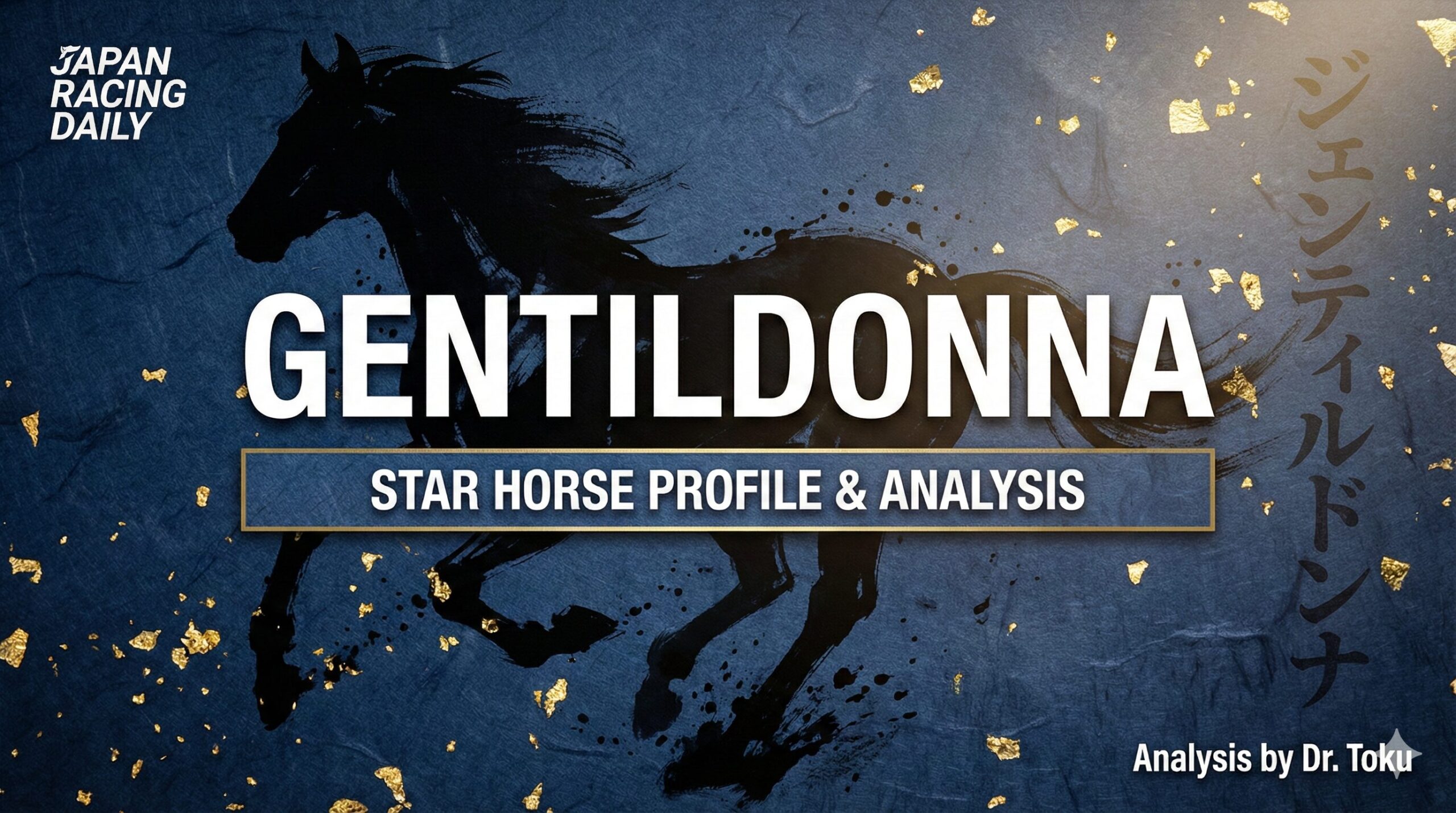
While Gold Ship did not run in the famous 2012 Japan Cup (where Gentildonna famously bumped Orfevre aside to win), he clashed with her in other major races like the Takarazuka Kinen and Arima Kinen. Gentildonna represented everything Gold Ship wasn’t: she was consistent, professional, and terrified opponents with her perfection.
In the 2013 Takarazuka Kinen, Gold Ship defeated her, proving that on his day, his stamina could overcome her precision. But in the 2014 Arima Kinen, Gentildonna took the glory in her retirement race. Their rivalry was a clash of philosophies: the erratic genius versus the disciplined queen.
Just A Way — The Best Friend
While Gentildonna was a rival, Just A Way was a friend. In the stables, Gold Ship and Just A Way were neighbors.
Just A Way was a late bloomer who eventually became the highest-rated horse in the world in 2014. It is famously said that the volatile Gold Ship was only calm when he was near Just A Way. The anime reflects this by occasionally showing them together or referencing their bond. It adds a layer of sweetness to Gold Ship’s character—he wasn’t a monster; he just had very specific preferences about who he liked.
Why Gold Ship Became a Cultural Icon in Japan
It is rare for a horse to transcend the sport of racing, but Gold Ship did it. He is, without hyperbole, one of the most famous animals in modern Japanese history.
His popularity stems from the Japanese concept of “romance” in sports. While Japanese culture often values precision, rule-following, and perfection, there is a deep, underlying love for the flawed hero—the one who does things their own way. Gold Ship was the ultimate individualist in a collectivist society.
Long before Umamusume was released, Gold Ship was already a meme. Photos of him making weird faces circulated on Twitter (now X) constantly. Merchandise of Gold Ship—plushies, towels, keychains—outsold many human athletes. Even people who never gambled knew who “Golshi” was.
When Umamusume exploded in popularity, it didn’t introduce Gold Ship to the world; it simply reminded everyone why they loved him. It allowed a new generation to look up the old race videos, to see the “warp” in the mud, to witness the Takarazuka Kinen disaster, and to realize that truth really is stranger than fiction.
He represents the idea that you can be successful, you can be a champion, and you can still be a complete weirdo. You don’t have to fit the mold to be great.
Conclusion
Gold Ship retired in 2015 after a career that was equal parts glorious and frustrating. He now lives a comfortable life as a stud horse in Hokkaido, passing on his grey coat and, presumably, his quirky personality to a new generation of foals.
For fans of Umamusume, Gold Ship is the perfect entry point into a deeper appreciation of horse racing. He proves that the “character quirks” you see in the anime aren’t just lazy writing; they are loving tributes to a horse that captivated a nation.
The next time you see the anime character pull a Rubik’s Cube out of nowhere or tackle her trainer, remember the real horse standing in the gates at Hanshin Racecourse, screaming at the sky while millions of dollars evaporated. Remember the mud-splattered demon of the Satsuki Sho.
Gold Ship wasn’t just a racehorse. He was an event. And there will likely never be another one like him.
If you enjoyed this deep dive into the real history behind the Umamusume characters, be sure to explore the rest of Japan Racing Daily. We have detailed profiles on the greatest heroes of the Japanese turf, bridging the gap between anime fandom and real-world racing history.





Comments