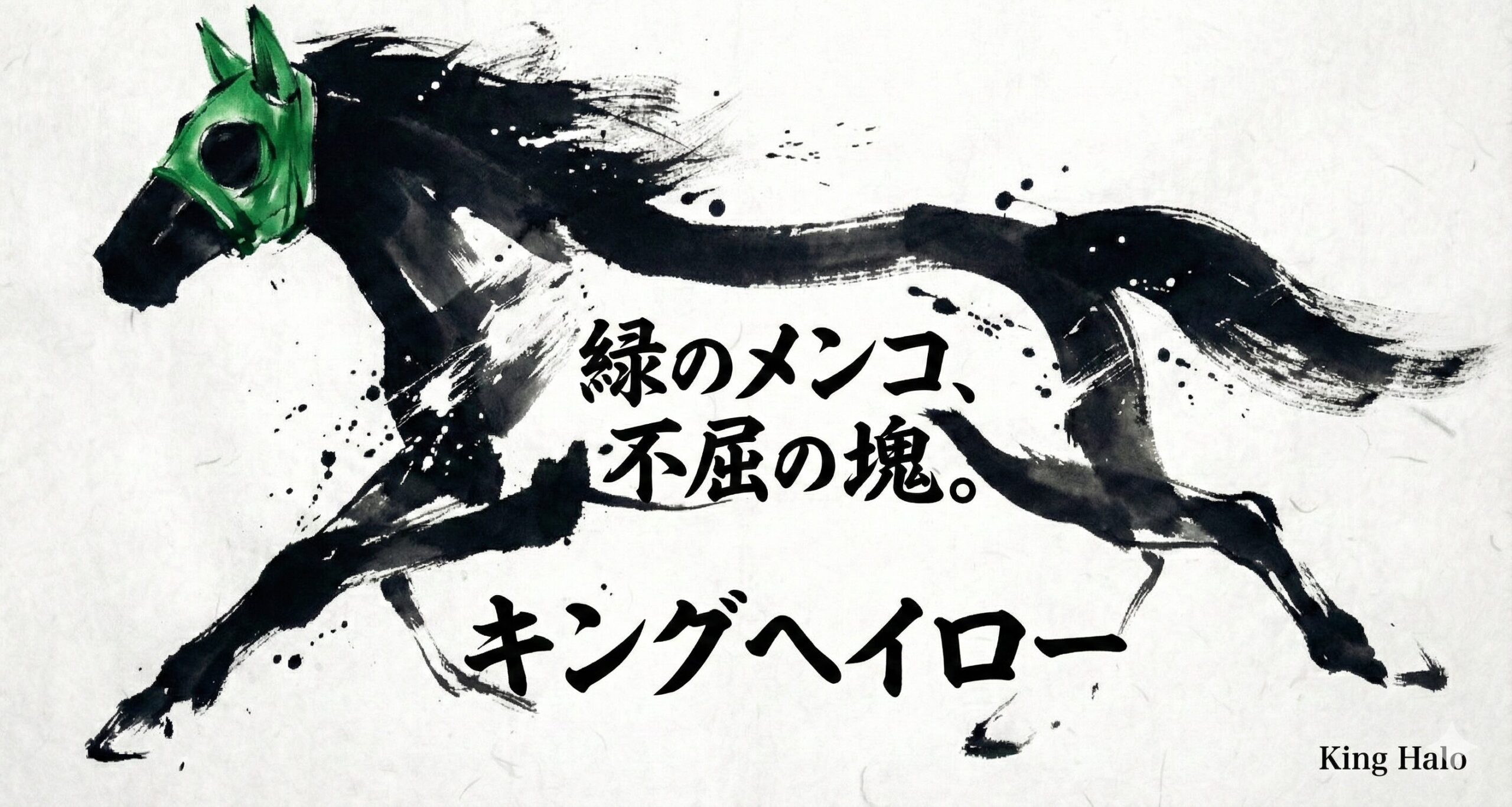
By Dr. Toku, Horse Racing Historian
In the colorful world of Umamusume Pretty Derby, few characters command the screen quite like King Halo. With her high-pitched “Ohoho!” laugh, aristocratic demeanor, and entourage, she initially appears to be the stereotypical “Ojou-sama” (wealthy young lady) rival.
However, anime fans soon realize that beneath the bravado lies one of the most poignant stories of resilience in the franchise. King Halo isn’t just a gag character; she is a tribute to a real racehorse who carried the weight of the world on his shoulders and fought for every inch of respect he earned.
Here is the true history behind the King—a story of golden expectations, crushing defeats, and a glorious, hard-won redemption.
The High-Pride Ojou-sama
In Umamusume Pretty Derby, King Halo is defined by her pride. She constantly speaks of her “destiny” to stand above all others. Yet, her story is often one of struggle. She faces constant losses against rivals like Special Week and Seiun Sky, leading to moments of genuine vulnerability where she questions her own worth.
This characterization is a direct mirror of reality. The real King Halo was born with a “silver spoon” in his mouth but had to walk a muddy, difficult road to glory. Her refusal to give up in the anime is the ultimate homage to the horse’s career.
The Real History: Born to Be King
If there was ever a horse born with a “Golden Spoon,” it was King Halo.
- His Father: Dancing Brave, a European legend and winner of the Prix de l’Arc de Triomphe.
- His Mother: Goodbye Halo, an American legend and 7-time G1 winner.
When King Halo was born, the Japanese Horse Racing world expected immediate dominance. He was priced at nearly 300 million yen before he ever stepped onto a track. The pressure was immense: he wasn’t just expected to win; he was expected to rule.
Early Brilliance (The Golden Generation)
King Halo debuted in late 1997, and for a moment, it looked like the prophecy would come true. He won his first three races with devastating speed. His victory in the Tokyo Sports Hai Sansai Stakes was a masterclass, showcasing a terrifying turn of foot that made fans believe a new hero had arrived.
However, 1998 brought the “Golden Generation”—one of the strongest eras in history. King Halo found himself locked in a bitter rivalry with Seiun Sky (the trickster escape artist) and Special Week (the Japanese dream).
While talented, King Halo began to falter on the biggest stages. He finished second to Seiun Sky in the Satsuki Sho. In the Japanese Derby, tragedy struck—he lost his composure, ran away with the jockey, and finished 14th. The “King” was becoming known not for winning, but for his frustrating inability to clinch the big title.
The Struggle & Persistence (1999)
For much of 1999, King Halo was dubbed a “Silver Collector” or “Bronze Collector.” He would run bravely, often finishing well, but he couldn’t break through the wall of the G1 level.
Yet, he never stopped running. Unlike many elite horses who retire when their prime fades, King Halo kept fighting. He found success in G2 races, such as the Nakayama Kinen, proving that he still had the fire to compete. This period defined his “Resilience”—he was beaten often, but he was never broken.
The Crowning Glory: 2000 Takamatsunomiya Kinen
By the year 2000, the “Golden Generation” had mostly retired or faded. But King Halo remained. His trainers made a bold decision: if he couldn’t win at the classic distances (2000m-3000m), why not try him as a sprinter?
It was a gamble that defined his career. In the Takamatsunomiya Kinen (1200m), the “King” finally found his throne. Charging from the middle of the pack, he unleashed a furious drive that overwhelmed the sprint specialists.
The commentary was unforgettable. As he crossed the line, it wasn’t just a win; it was a vindication. The horse that had run in the Derby (2400m) and the Kikuka Sho (3000m) had finally claimed his G1 title in a sprint. He proved he wasn’t a failure; he was just a late bloomer who needed to find his own path.
Legacy: The King Lives On
King Halo retired as a fan favorite, loved not for his dominance, but for his guts. His legacy, however, has only grown stronger in the breeding shed.
He became a phenomenal broodmare sire (mother’s father), passing on his tenacity and speed to new generations.
- Equinox: The world’s highest-rated horse of 2023 calls King Halo his grandfather (dam sire).
- Deep Bond: A beloved stayer known for his grit, also out of a King Halo mare.
- Dictyon: A powerful dirt runner who claimed the 2025 Tokyo Daishoten. Dictyon’s mother, Medea, is a daughter of King Halo, proving that the King’s bloodline can conquer both turf and dirt, just as he tried to conquer every distance.
Conclusion
King Halo’s story in Umamusume Pretty Derby resonates because it is honest. We are not all born winners, even if we have high expectations placed upon us.
The real King Halo taught us that even if you lose to your rivals, and even if you take the long way around, you can still reach the summit if you refuse to quit. He is, and always will be, the unyielding King.




Comments